


Social Media Marketing for Personal Trainers: What Actually Works
Updated June 2026
What works on social media for personal trainers is not "post your workouts." It's three native genres: relatable client humor ("POV: personal trainers be like"), emotional transformation storytime told through a real client's why, and education-as-entertainment form fixes. Instagram Reels and TikTok carry the reach, real coaching footage beats any polished graphic, and the free-intro offer should show up on only the small promotional slice of your calendar — roughly 10–20%.
If your last ten posts were a logo, a gym selfie, and "DM to book," that's the problem. Below is what the trainers who actually grow are filming, in the order it matters.
What kind of personal training content actually gets views?
The content that travels is the content that makes someone feel something or learn something fast — not your business announcements. Three veins do the heavy lifting for this trade, and none of them mention your studio in the first three seconds.
1. Relatable client humor. This is the single biggest comedy vein for trainers, and it earns the most shares. The formats are well-worn for a reason: "POV: personal trainers be like," "things my clients say every single week," "running into your trainer in public," and the affectionate "I bully them out of love" bit where you slide another plate on after a client calls a set "pretty heavy." Cold-open on the premise, act out two or three escalating client lines, freeze on the funniest face, and end on a question — never a sell. The whole point is the tag: "tag a gym buddy who does this."
2. Transformation storytime. The highest-save format in the trade, and the one that separates a trainer's account from a generic gym page. You don't lead with the body — you lead with the why. "Nobody knew the real reason she started training." "She almost didn't walk through the door." Then the backstory (postpartum return, a 40-plus comeback, coming back from injury), a montage of real sessions and small wins, and the milestone reveal in the client's own words. One hard rule: written consent before any client photo or video goes up. This is the category's non-negotiable.
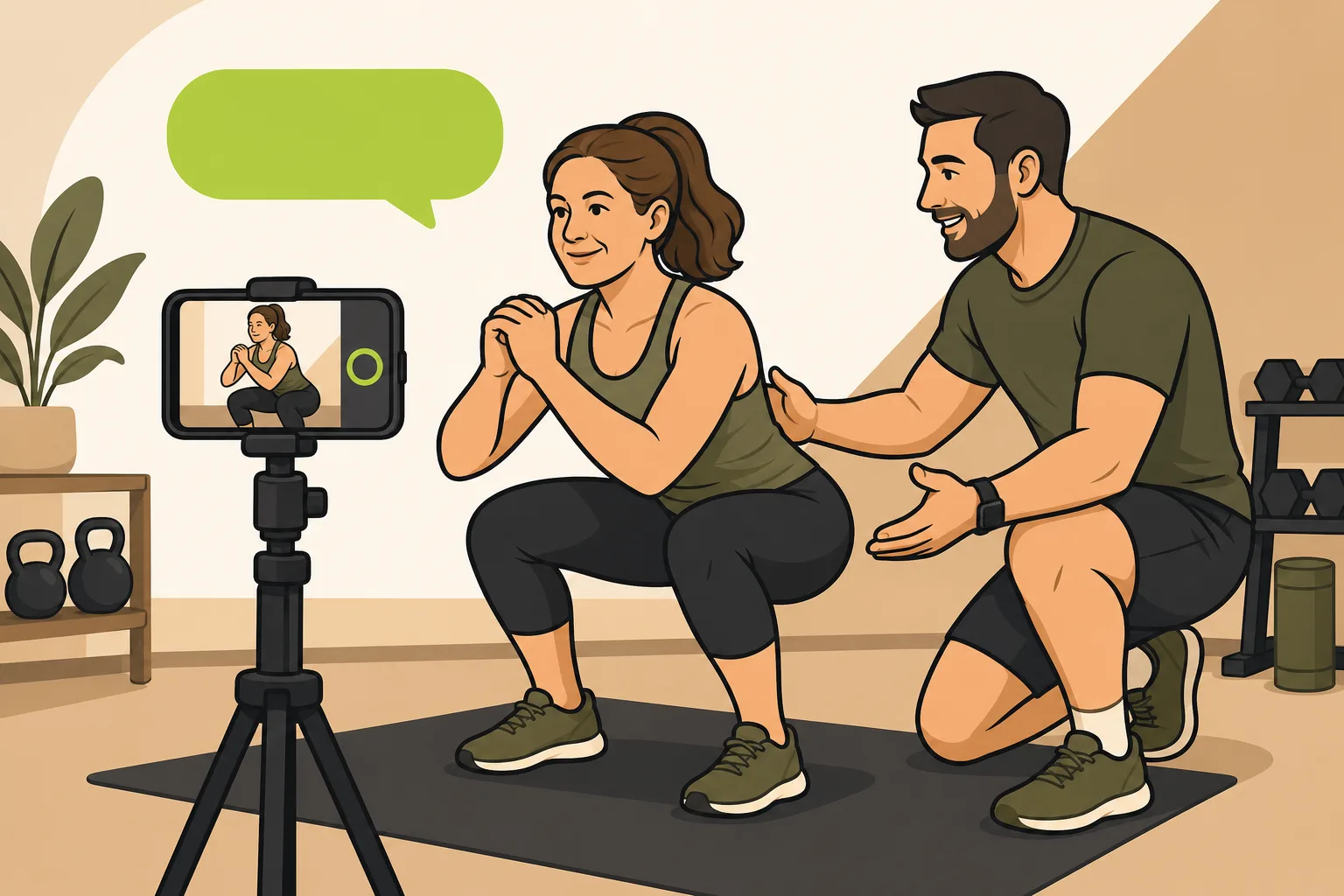
3. Education-as-entertainment. The most-saved utility content: "3 gym mistakes I see every single day," "if your lower back hurts at a desk all day, stop doing this," "fix your squat in 15 seconds." Show the wrong version, show the right version with one cue, give one sentence on why it matters, and close with "save this for your next session." That "save" prompt is engagement, not a booking ask — and saves now drive reach more than raw views.
What about trends, myth-busting, and engagement bait?
Yes — they're the supporting cast that keeps your account from feeling like a lecture. Four formats round out the playbook.
- Myth-bust / react. Stitch or duet a viral workout and react with personality: "personal trainer reacts to this workout," "things people get wrong about fat loss." End on an open question so the comments do the work. Stay compliant — no medical or guaranteed-result claims.
- The recurring character. A "day in the life of a [city] trainer," a GRWM-for-coaching, a catchphrase your account is known for. People come back for you, not the studio — that para-social loop is what turns viewers into clients.
- Trend participation. "This trending sound but it's leg day." Borrowed reach, but only while the audio is actually current — timing is the whole game.
- Engagement bait. "Guess the exercise from the shadow," "this or that: cardio vs weights." Pure comment-farming, and the algorithm reads those comments as a signal to push the post further.
One detail that matters across all of these: captions and on-screen text are always on. Most people watch muted, and your hook has to land in the first two to three seconds as text on the screen, not as something you say aloud.
Key takeaway: Roughly 70–80% of a winning trainer's calendar is humor, transformation storytime, and education — the organic genres people share and save. The free-intro CTA belongs on the promotional minority, not stapled to every post.
How often should personal trainers post — and where?
Aim for about 3–5 short-form videos a week, and treat consistency as more important than volume — a steady three posts a week beats seven-then-nothing. Stories are a separate layer: 3–5 a day to keep existing followers warm and quietly move them toward booking.
Platform priorities are clear for this trade:
| Platform | Role | Why it fits personal training |
|---|---|---|
| Instagram Reels | Primary reach + proof | Pushes video to non-followers; the feed is where prospects vet you |
| TikTok | Primary reach | Fastest-growing demographic is adults 25–34 — the busy-professional buyer |
| Secondary | Older local clients, community and event posts | |
| YouTube (Shorts + long) | Authority layer | Lower cadence, evergreen "how to" depth |
Hashtags have changed: as of late 2025, Instagram caps you at five per post, and three to five well-matched tags now beat stuffing. Mix one broad tag with a niche one and a local one — #fitover40 or #postpartumfitness plus #yourcitypersonaltrainer outperforms a wall of #fitness #gym #gains.
How is this different from a big-box gym's social?
Personal training social is built on a one-to-one relationship, so your content trades on the coach, not the equipment. A few category-specific rules follow from that.
- Feature real, normal-looking clients — busy adults, 40-plus, postpartum — not fitness models. It matches the "for regular people" positioning that builds trust in this trade.
- Never use stock or AI-generated fitness imagery. Across our proprietary local-business website research, top-ranking personal training competitors used exclusively real photography — zero stock-heavy sites in the set. The same authenticity bar applies to social, and a single stock clip torpedoes it.
- Keep tough-love humor clearly affectionate, never genuinely demeaning, and never use fear, guilt, or body-shaming framing.
- Don't run a wall of "book in bio." It kills organic reach. The free intro — this category's number-one conversion action — earns its place on the promotional slice and nowhere else.
It's the same authenticity instinct that should run through your whole web presence. The strongest personal training sites we analyzed lead with real coaching photos and a numeric review count — "5.0 stars, 500+ Google reviews" sitting right next to the free-intro button — rather than stock imagery and vague "trusted" copy. You can see the full pattern in our personal training website breakdown.
This is a lot of work every week. Who actually does it?
Honestly? Most trainers can't keep this up — and that's the real problem, not knowing what to post. A real calendar means filming several Reels a week, writing muted-friendly captions, posting Stories daily, keeping hashtags fresh every few months, riding trends while they're trending, and tracking consent on every client clip. After a full day of coaching, the camera is the first thing to get dropped.
That's where the done-for-you side comes in. GrowLocal builds and hosts your personal training site and writes your social posts — and because we already know your trade and your brand, the posts come out as the genres above, not generic filler. The humor bit, the consented transformation storytime, the form-fix tip, the seasonal "don't wait until January" push — written in your voice, on the right cadence, with the free-intro CTA placed only where it belongs.
You still bring the thing only you can: the real footage of you coaching real clients. We handle the rest of the calendar around it. If you want the website and the social handled together, start with GrowLocal — or see how we approach local business websites across every trade.
Frequently Asked Questions
What should a personal trainer post on Instagram?
Lead with the three native genres: relatable client humor ("things my clients say"), emotional transformation storytime built around a client's real why, and quick form-fix tips ("3 gym mistakes I see every day"). Keep those organic — save the free-intro offer for the small promotional share of your calendar.
How often should a personal trainer post on social media?
Aim for about 3–5 short-form videos a week plus 3–5 Stories a day. Consistency matters more than volume — a steady three posts a week beats a burst of seven followed by silence. Stories warm your existing followers; Reels and TikToks bring in new ones.
Is TikTok or Instagram better for personal trainers?
Both — they're your two primary reach engines, and most trainers post the same vertical video to each. TikTok's fastest-growing audience is adults 25–34, the busy-professional buyer, while Instagram doubles as the proof layer where prospects vet you before booking. Facebook and YouTube are lower-cadence secondary channels.
Do I need professional photos and a videographer to post?
No — and you actively shouldn't fake it. Phone-shot footage of you coaching a real client in your real studio is exactly what wins this category; across our proprietary local-business website research, top personal training competitors used real photography with zero stock. Stock or AI-generated fitness imagery breaks the trust your content is built on.
Can I post client before-and-after photos?
Only with written consent — this is the category's hard rule, every single time. The strongest versions use the client's own words over their before and after, lead with the emotional reason they started, and never promise guaranteed results or a specific weight loss. Frame it as proof and pride, not an ad.
I don't have time to do all this — what are my options?
You can batch-film once a week and schedule ahead, or hand the calendar off entirely. GrowLocal builds your personal training site and writes your social posts in the genres above — already matched to your trade and brand — so the only thing you supply is real coaching footage. It's the same done-for-you approach we bring to local business websites generally.