


Social Media Marketing for Photographers: What Actually Works
Updated June 2026
Social media marketing for photographers works when you stop posting finished photos and start posting the moments around them. The reach engine for this trade is five native genres — the satisfying behind-the-scenes-to-final transition, relatable client-trope humor, emotional reaction storytime, trending-audio highlight reels, and your own face as a recurring character. People book the photographer, not the studio, so the content that travels shows the person and the process, not a portfolio wall with "book now" stamped on it. This guide breaks down each format with concrete post ideas, the realistic posting cadence for a solo studio, and how to keep it running every week without burning out.
What kind of photography posts actually get reach?
The posts that get reach are the ones that don't sell. For photographers, five organic genres do almost all the work, and finished portfolio shots alone are the weakest of them. The reach comes from showing how the photo gets made, the feeling it captures, and who you are — the polished frame is the payoff, not the post.
A healthy photographer calendar runs roughly 75% organic, 25% promotional. Lead a feed with discount CTAs and reach collapses — a wall of "book in bio" is the single fastest way to kill a photographer's algorithm. Earn the audience first with the genres below, then let a small slice of promotional posts convert them.
The five veins that travel
- Satisfying transition reels — the messy-set-to-final-frame snap, and the editing glow-up.
- Relatable humor — the client-trope bits every photographer has lived.
- Emotional storytime — the first-look reaction, the parent's face.
- Trend participation — your best frames cut to whatever audio is hot this week.
- Recurring character — your face, your voice, your day, on repeat.
What is the "satisfying" photographer format everyone copies?
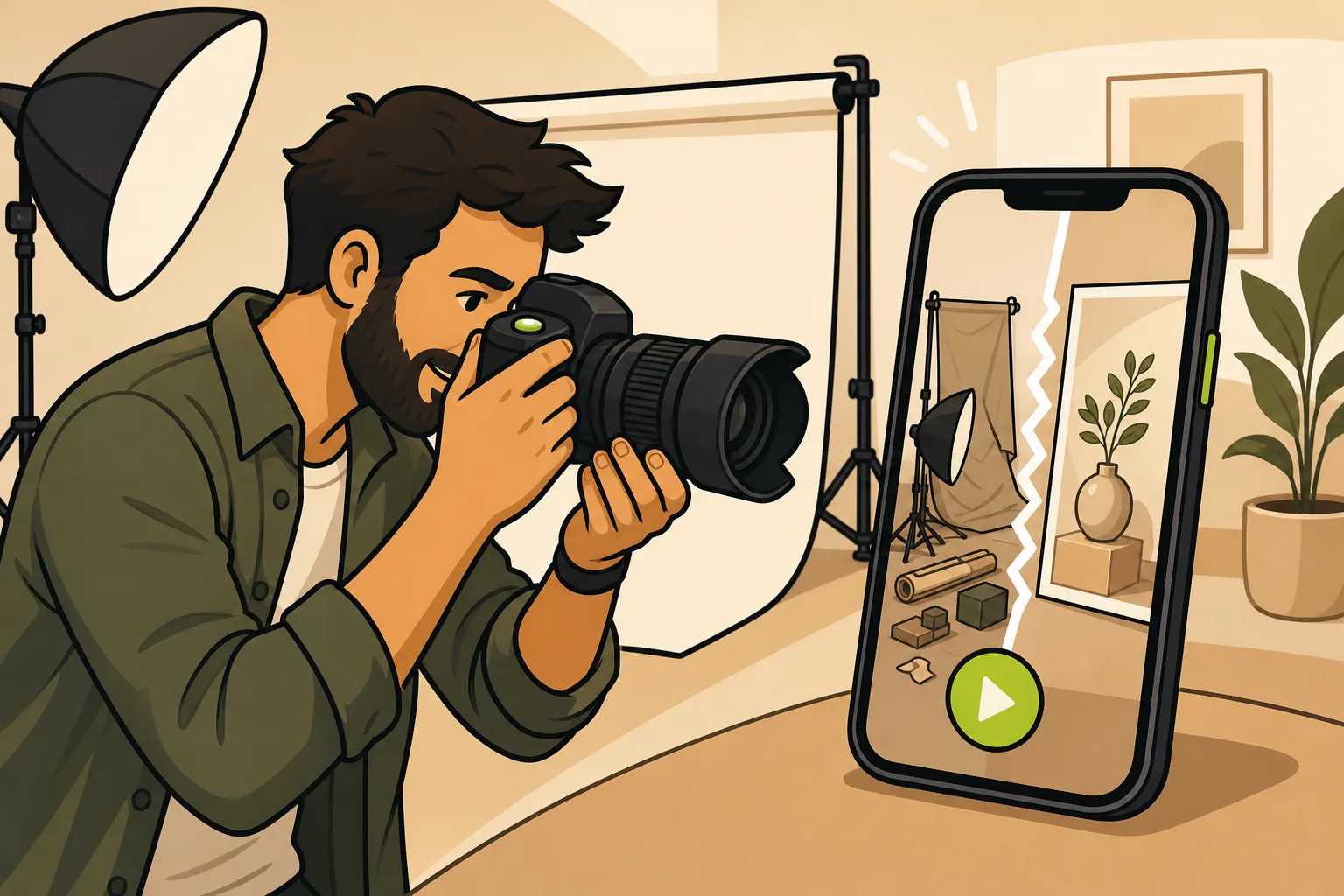
The satisfying format is the behind-the-scenes clip that transitions into the finished photo. You film the set handheld — the awkward posing, the light, the chaos — then on a beat drop you cover the lens with your hand or whip the camera and reveal the polished final image. It's the single most repeatable reel in this trade. The #photoshoot-bts tag alone carries roughly 225,000 reels, which tells you how reliably the format performs.
The trick is keeping the behind-the-scenes part raw. A handheld, slightly shaky clip signals "this is real" — and that authenticity is exactly what makes it travel. Heavy color grading and fancy transitions on the BTS portion read as fake and kill the effect. Quick cuts, upbeat trending sound, polished payoff. That's it.
The close cousin is the editing before/after: a flat, straight-out-of-camera RAW frame on screen, then a satisfying slider or wipe to the graded final. "Same photo, two minutes of editing." It's watch-bait, not an ad — never bolt a booking CTA onto it. Both formats answer a buyer's quiet question ("can this person actually deliver?") without a word of selling.
How do photographers use humor without looking unprofessional?
Photographers use humor by leaning into the client tropes every working shooter has heard. The bits write themselves: "can you send me the RAW files," "make me look skinnier," "my friend has a camera but I picked you," "POV: client wants 500 edits by tomorrow." You film a simple talking-to-camera or POV bit with on-screen captions and a trending comedic sound — no polish required, personality carries it.
This vein gets shared more than almost anything else because it's relatable to both peers and clients. A perennial favorite is the "you're so creative — thanks, I used to cry during math homework" format, where the setup line is on-screen text and the punchline cuts to your real creative work or your 2am editing grind. It's self-aware, it's a love letter to creatives, and it does not look unprofessional — it makes you look human, which is the whole point in a trade where people hire a personality.
What kind of photo content makes people cry (and book)?
Emotional storytime makes people cry, and in this trade emotion converts. The format is the unscripted reaction: the father seeing his daughter, the partner's face the instant they see the bride, the full "getting ready → first look → vows" arc. You hook on the quiet build-up, hold on the genuine reaction, and close on the still photo that captured it — no ask.
The key is the arc, not the peak alone. One Idaho wedding photographer's before-and-after reaction clip was widely reported at over 150 million views — and it traveled because of the emotional build, not because anyone pitched a package. Lead with "watch his face the second he sees her" and let the moment breathe.
Two non-negotiables: get explicit consent before posting client faces, and never mine grief, sensitive, or boudoir sessions for content-bait. The emotion has to be one your clients are proud to have shared.
Should photographers chase trends and post their own face?
Yes — trends and your own face are two of the five core veins, and they compound the other three. Trend participation means saving a currently-trending audio (look for the little arrow icon), then cutting your strongest portfolio frames to it — "my best 10 shots to [trending sound]," "a year of sessions in 15 seconds." Trends decay fast, so treat it as a weekly slot you fill with whatever's hot, not a one-time post. The caution: chase trends that fit your brand and ideal client, not random dance challenges that pull the wrong audience.
The recurring character vein is the quiet superpower of this trade. In photography, people book the person — so meet-the-photographer intros, day-in-the-life vlogs, the husband-wife-duo bit, the studio dog, your signature catchphrase all build a face viewers feel they already know. A simple "a day in the life of a [city] photographer" — gear pack, drive, the shoot, the candid moments, a warm "that's a wrap" — outperforms a polished promo because it sells you, not a service.
| Vein | Example post | Why it travels |
|---|---|---|
| Satisfying transition | Lens-cover wipe from messy set to final frame | Authentic process, payoff on the beat |
| Editing before/after | RAW-to-graded slider, "2 minutes of editing" | Pure satisfying watch-bait |
| Relatable humor | "Photographers when the client says 'send me the RAWs'" | Highly shareable across peers + clients |
| Emotional storytime | "Watch his face the second he sees her" | The arc makes viewers feel it |
| Trend participation | Best-10-shots montage to the week's hot audio | Borrowed reach from the algorithm |
| Recurring character | "A day in the life of a [city] photographer" | People book the person, not the studio |
Key takeaway: The photo is the product, so the posts that work show how it gets made and who makes it — keep the calendar ~75% organic across these five veins, and the ~25% promotional slot will actually convert.
How often should a photographer post — and on which platform?
Consistency beats volume: a sustainable 3–5 posts a week outperforms a burst-then-silence pattern for a solo studio. Reach follows whoever shows up steadily, not whoever floods the feed for one week and disappears.
Realistic baseline cadence by platform:
- Instagram — the #1 booking-source platform for photographers; organic Reels routinely out-book paid ads. Aim for ~1 feed post/day, 2–3 Reels/week, 2–3 Stories/day.
- TikTok — home of BTS, humor, tutorials, and storytime; 1–4 posts/day, no organic cap.
- Pinterest — uniquely high-value for wedding, family, and maternity work, because couples plan there and search a booked venue by name. Pin 3–4 times/week and geotag the venue so it reshares you.
- Facebook — local discovery and reshares; every 1–2 days.
One mechanical habit pays off above all: geotag the venue and tag every vendor — planner, florist, HMUA — on wedding posts. Vendors reshare to their audiences, and you become a walking billboard inside the exact local market that books you. Photography demand is also seasonal and books far ahead, so the calendar shifts: engagement-season nudges in November–February, fresh real-wedding Reels May–October, and fall family mini-session pushes September–November.
Isn't this a lot of work every single week?
Yes — and that's the honest catch. Five organic veins, three to five posts a week, across three or four platforms, every week, forever, is a real second job on top of shooting and editing. Most photographers start strong and stall by week three, right when the algorithm was about to reward the consistency.
This is also where your website and your social have to pull in the same direction. The genres above earn attention; your site is where that attention becomes an inquiry. In our proprietary local-business website research, 92% of local business websites hide pricing entirely — funneling visitors to a quote form — which is exactly the right pattern for this taste-driven, premium category, as long as the inquiry path is fast and the portfolio is real. (See our full pricing-transparency data.) And in this category specifically, stock imagery is disqualifying: across dozens of categories in our research, top-ranking competitors used exclusively real photography — for photographers, the photos are the product, so the site must show actual client work. Here's how the best photography websites are built around exactly that.
GrowLocal builds and hosts that fast, real-work site for you — and then writes your social posts too. Because we already know your trade and your brand, we can run the photographer playbook on your behalf: the BTS-to-final transition, the relatable client-trope bit, the trend reel, the day-in-the-life. You keep shooting; the weekly cadence runs without you babysitting a content calendar. See how it fits across every local trade we build for, or the dedicated photography website breakdown.
Frequently Asked Questions
What should photographers post on Instagram to get bookings?
Lead with the satisfying behind-the-scenes-to-final transition and editing before/afters, mix in relatable client-trope humor and emotional first-look reactions, and reserve a small slice for named testimonials and seasonal booking nudges. Instagram is the #1 booking-source platform for photographers, and organic Reels in these genres consistently out-book paid ads. Keep roughly 75% of the calendar organic so the algorithm keeps showing you.
How often should a photographer post on social media?
A sustainable 3–5 posts per week beats a burst-then-silence pattern for a solo studio, because consistency drives reach more than raw volume. On Instagram that looks like one feed post a day, 2–3 Reels a week, and a couple of Stories daily. On TikTok you can post 1–4 times a day with no organic penalty.
Does Pinterest actually matter for photographers?
Yes, especially for wedding, family, and maternity photographers, because couples plan there and search booked venues by name. Pin 3–4 tall images a week, write keyword-rich titles with the venue, city, and genre, and geotag the venue so it surfaces your work to people actively planning. It functions as a search engine, not a feed.
What kind of photography posts go viral?
Emotional reaction clips and satisfying transition reels travel the furthest — one Idaho wedding photographer's reaction clip was widely reported at over 150 million views off the emotional arc alone, not a sales pitch. The behind-the-scenes-to-final transition is the most repeatable viral format, with the #photoshoot-bts tag carrying roughly 225,000 reels. Both work because they show the moment or the craft, never a hard sell.
Do I need a website if I already post on Instagram?
Yes — Instagram earns attention, but your website is where attention becomes a booked inquiry, and the two reinforce each other. In our proprietary local-business website research, 92% of local business websites hide pricing entirely and route visitors to an inquiry form, which fits this premium, taste-driven category as long as the portfolio is real client work, not stock. Social drives discovery; a fast, real-work photography website closes it.
Can I get my social posts written for me?
Yes — GrowLocal writes done-for-you social posts as part of building and hosting your site, using the photographer playbook above. Because we already know your trade and brand, the BTS transitions, humor bits, trend reels, and day-in-the-life posts run on a steady weekly cadence without you managing a content calendar. You keep shooting and editing; the consistency the algorithm rewards happens in the background.